The stepped wedge trial design: a systematic review PMC
Table Of Content
- Considerations Before Selecting a Stepped-Wedge Cluster Randomized Trial Design for a Practice Improvement Study
- How to proceed when outcome parameter variance and time-dependent correlation are unknown
- Authors’ original submitted files for images
- Data extraction and analysis
- TRESemmé TRES Two Extra Firm Control Gel
For static sites, I love using Gatsby for creating blazing fast, SEO-driven headless frontend user interfaces. It depends on the wedge style and what activity you’re doing, but in general, most wedges can be worn all day. The design of the sole evenly shifts your weight, making wedges comfortable to wear and move in for hours. Most wedges also have a small platform at the front of the footbed, which further cushions your foot for all-day wear. This breezy, slip-on cork wedge from Cushionaire has a stretchy gore upper that adjusts to your foot’s shape while keeping it secure as you walk, so blisters won’t develop. Cork is naturally springy and compressible, so it absorbs the impact of your steps and minimizes stress on your feet, ankles and knees.
Considerations Before Selecting a Stepped-Wedge Cluster Randomized Trial Design for a Practice Improvement Study
Whilst the clusters in an SWT normally participate throughout the trial, experiencing control and intervention conditions at different times according to the allocation strategy, the ways in which individuals are exposed and participate vary greatly between trials. For example, in some SWTs, all individuals participate in the trial from start to end and experience both control and intervention conditions. These features are often outside the control of the trialists, but influence how SWTs are designed. In other SWTs where large clusters (such as cities) are randomised, then only a small fraction of the participants may be invited to provide outcome measurements, for example by a questionnaire survey. Stepped wedge cluster randomised trials (SWTs) are becoming increasing popular and are being applied to a growing range of interventions, as shown in our review article [1].
How to proceed when outcome parameter variance and time-dependent correlation are unknown
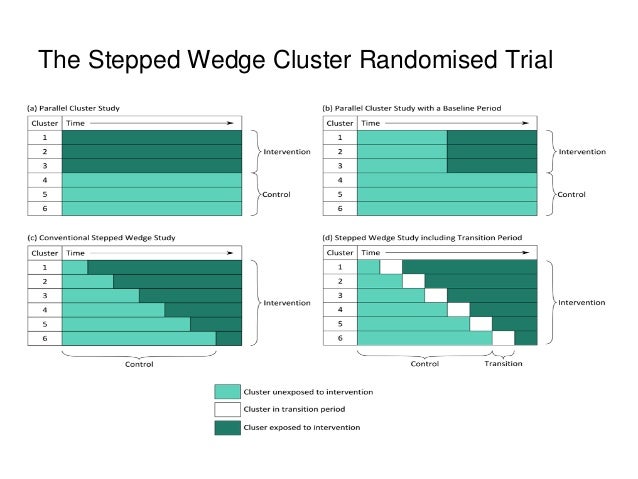
These groups are generally—as well as in the rest of this article—referred to as clusters. Considering the scientific advantages of the stepped wedge design, it has rarely been used in practice and hence we advocate the design for evaluating a wide range of interventions, although we are not the first to do so [26-28]. The conduct of the stepped wedge cluster randomised trial bears much in common with the main alternatives—the parallel cluster trial and the parallel cluster randomised trial with a baseline period. Since all these designs are used to study similar policy and service delivery interventions, they raise many of the same issues, particularly those relating to selection and concealment.
Authors’ original submitted files for images
Though substantial carry-over effects are uncommon in stepped wedge trials, researchers should consider their possibility before conducting a trial in which individuals experience both control and intervention conditions, such as a closed or open cohort trial. Stepped wedge randomised trial designs involve sequential roll-out of an intervention to participants (individuals or clusters) over a number of time periods. By the end of the study, all participants will have received the intervention, although the order in which participants receive the intervention is determined at random. Stepped wedge designs offer a number of opportunities for data analysis, particularly for modelling the effect of time on the effectiveness of an intervention.
Data extraction and analysis
In other words, one cannot conclude from the trial data that the intervention has a positive effect on patients’ physical quality of life. Proforma used to extract data from the included papers or protocols prior to generating a database from these data. Where only one figure for the number of participants is given, each individual/household participant receives the intervention at some stage during the trial.
Table 1
In such circumstances, the alternative to a stepped wedge design may not be a parallel cluster trial but a weaker, non-experimental design. Under such a scenario the stepped wedge design is “naturalistic” in that the implementation may proceed much as it would have done had the evaluation not been in place while allowing randomised evidence of effectiveness. In the preceding section we have seen that a complete SWT may be of longer duration or fewer steps than wished, because a long step length is selected due to a lag period.

Key Messages
This makes blinding of those assessing outcomes particularly important in protecting against information biases, particularly where outcomes are subjective. None of the studies in the sample provided enough detail to determine whether outcome assessments were blinded, with one study [14] deciding not to blind assessors to help maintain response rates. The intervention in this study involved improvements to housing, with health and environmental assessments undertaken in participants' homes so that participants would not have to travel to a 'neutral' location. While the stepped wedge design offers a number of opportunities for use in future evaluations, a more consistent approach to reporting and data analysis is required. The stepped wedge is a pragmatic study design that reconciles the constraints under which policy makers and service managers operate with the need for rigorous scientific evaluations. While researchers may believe an evaluation of an intervention is required, it is decision makers (that is, politicians and managers) who control resources for system change.
Stepped Wedge Cluster Randomized Designs for Disease Prevention Research
In 2007 Hussey and Hughes4 first described methods to determine statistical power available when using a stepped wedge design. However, there is a dearth of literature on the more general methodological aspects, such as the rationale for, and conduct of, stepped wedge studies. In this article we illustrate how this new study design differs from the conventional parallel design and its variations. We also give several examples and consider several design and methodological issues, including rationale, sample size, and efficiency compared with competing designs, and highlight some important reporting and analysis considerations. Considering the scientific advantages of the stepped wedge design, it has rarely been used in practice and hence we advocate the design for evaluating a wide range of interventions, although we are not the first to do so [26–28]. The stepped wedge design may also be appropriate for cost-effectiveness analyses of interventions that have already been shown to be effective.
TRESemmé TRES Two Extra Firm Control Gel
Intracluster correlation coefficients in the Greater Mekong Subregion for sample size calculations of cluster randomized ... - Malaria Journal
Intracluster correlation coefficients in the Greater Mekong Subregion for sample size calculations of cluster randomized ....
Posted: Wed, 18 Dec 2019 08:00:00 GMT [source]
This process continues until all clusters have crossed over to be exposed to the intervention. Data collection continues throughout the study, so that each cluster contributes observations under both control and intervention observation periods. It is a pragmatic study design, giving great potential for robust scientific evaluations that might otherwise not be possible. The stepped wedge cluster randomized design has received increasing attention in pragmatic clinical trials and implementation science research.
The key feature of the design is the unidirectional crossover of clusters from the control to intervention conditions on a staggered schedule, which induces confounding of the intervention effect by time. The stepped wedge design first appeared in the Gambia Hepatitis Intervention Study in the 1980s. However, the statistical model used for the design and analysis was not formally introduced until 2007 in an article by Michael A. Hussey and James P. Hughes. Since then, a variety of mixed-effects model extensions have been proposed for the design and analysis of these trials.
We classified recently published stepped wedge trials using this framework and identified illustrative case studies. This extended procedure was used to obtain the findings shown in Box 2 by analyzing the sample SWD trial described in Table 3. Full details of the procedure can be found in the documentation relating to software programs for analyzing mixed linear models such as the SAS PROC MIXED Procedure (9). Such complex statistical models should also be used to analyze trials in which correlations between repeated measurements are assumed to be due to intraindividual effects. Among others, this this typically implies that the variation between clusters cannot be described any longer in accordance with Condition 2 by a single dispersion parameter.
A critical consideration in using existing tools for sample size calculation is the assumptions on unknown ICCs. It has been encouraged in the CRT and SW-CRT literature7071 to report ICCs to facilitate the design of future trials with similar endpoints. By providing key conceptual and analytical considerations, we aspire to encourage researchers to evaluate the potential for adopting a stepped wedge design in their study and thereby help with generating high-quality treatment effect evidence for patient care. When outcomes are not based on routinely collected data or when individual recruitment is required, as in all cluster trials, special consideration should be given to minimising selection biases. Incomplete designs have been proposed in which data are not collected from all clusters at all times.
Just as simple as calculating the limits of confidence intervals is statistical testing of the null hypothesis that the “true” treatment effect ? Both authors contributed to the conceptualization of, drafting, reviewing and editing the manuscript. SWGRTs should only be used when all efforts to implement a more conventional parallel GRT have been exhausted.


Comments
Post a Comment